


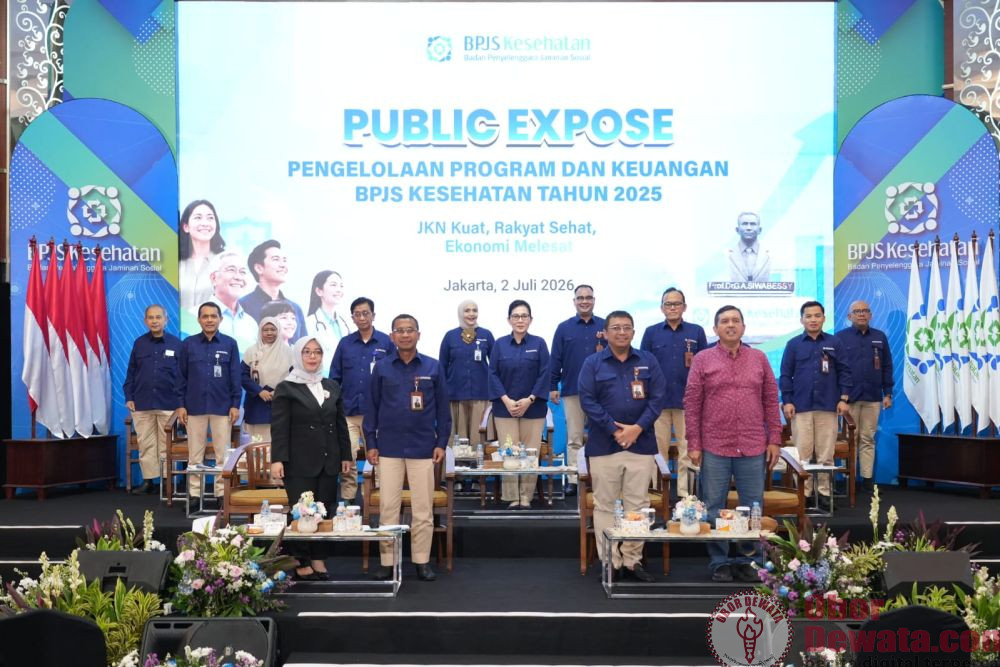
JAKARTA, OborDewata.com – The National Health Insurance (JKN) program has demonstrated its vital role as the foundation for building healthy, productive, and competitive Indonesian human resources. Entering more than a decade of implementation, the JKN program has not only succeeded in expanding public access to quality healthcare services but has also maintained program sustainability through good governance, sound financial conditions, and increasingly accessible service innovations.
These achievements were presented by the President Director of BPJS Kesehatan, Prihati Pujowaskito, during the Public Expose of the 2025 JKN Program Management Report and Financial Report. The event serves as a form of BPJS Kesehatan’s accountability to the public and a demonstration of information transparency regarding the management of the JKN Program throughout 2025, on Thursday (2/7).
”The JKN Program does not merely provide health service financing guarantees; it serves as the foundation for creating healthy, productive, and competitive Indonesian human resources. When the public can access quality healthcare services without being burdened by high costs, they can continue to create, increase productivity, and make a tangible contribution to national development,” said Pujo.
As of December 31, 2025, the number of JKN Program participants reached 282.7 million people, or 98.62 percent of Indonesia’s total population. This massive universal health coverage is accompanied by high utilization of healthcare services. Throughout 2025, the JKN Program recorded more than 725.3 million healthcare service utilizations, averaging over 1.9 million service utilizations per day.
”These figures reflect high public trust in the JKN Program, while also showing that quality healthcare services are becoming increasingly accessible to participants across Indonesia. Furthermore, BPJS Kesehatan consistently strengthens digital transformation through various service channels,” Pujo added.
Innovations in JKN services include the Mobile JKN Application, Administration Services via WhatsApp (PANDAWA) at 08118165165, and Care Center 165. This ease of access is further bolstered by the expansion of the healthcare facility network, which now partners with 23,770 Primary Health Care Facilities (FKTP), 3,194 Advanced Referral Health Facilities (FKRTL), and 6,190 supporting health facilities spread across Indonesia.
Pujo explained that the successful implementation of the JKN Program is also supported by the healthy and accountable management of the Health Social Security Fund (DJS). By the end of 2025, the net assets of the DJS Kesehatan were recorded at IDR 30.04 trillion, capable of meeting estimated claim payments for 1.88 months, in compliance with applicable regulations. Meanwhile, investment returns from the Health Social Security Fund reached IDR 3,94 trillion, reflecting prudent fund management oriented toward program sustainability.
”This commitment is also reflected in various organizational governance achievements. For the 2025 financial year, BPJS Kesehatan once again received an Unmodified Opinion (WTM) from the Public Accounting Firm for the 12th consecutive time, or the 34th time since the era of PT Askes (Persero). Additionally, BPJS Kesehatan scored 97.67 in the organizational governance assessment, 4.01 in Governance, Risk, and Compliance (GRC) maturity, 685 in the Baldrige Excellence Framework (BEF), and 80.48 in the Integrity Assessment Survey conducted by the Corruption Eradication Commission (KPK),” Pujo explained.
According to Pujo, the benefits of the JKN Program are felt not only in the health sector but also have a tangible impact on national economic development and social welfare. Based on a study by the Institute for Economic and Social Research, Faculty of Economics and Business, Universitas Indonesia (University of Indonesia) or LPEM FEB UI, the JKN Program contributed up to IDR 129 trillion to the national Gross Domestic Product (GDP), created around 3.5 million jobs, and generated a multiplier effect on the health services sector, food and beverage industry, and social services.
Moreover, the JKN Program successfully lifted approximately 8.1 million people out of poverty during the 2018–2019 period and protected around 16 million people from the risk of falling into poverty due to healthcare costs. Pujo explained that the study also showed that every 1 percent increase in JKN Program membership can increase per capita expenditure by 2.71 percent, while contributing to a three-year increase in life expectancy and enhancing public productivity.
”This demonstrates that the JKN Program is a crucial instrument in strengthening social protection while supporting national productivity. On the other hand, BPJS Kesehatan realizes that the sustainability of the JKN Program must be maintained in line with the increasing public demand for healthcare services,” Pujo added.
Pujo also revealed that throughout 2025, healthcare service costs reached IDR 191.3 trillion, an increase from the previous year. Out of this total, 26.42 percent was used to finance catastrophic illnesses, most of which could actually be prevented through a healthy lifestyle and early detection. Therefore, BPJS Kesehatan continuously optimizes promotive and preventive efforts, enhances service quality, optimizes premium collectability, and strengthens cost control to ensure the JKN Program remains sustainable and capable of providing benefits for future generations.
”The success of the JKN Program is the result of the collective efforts of the entire nation. BPJS Kesehatan is committed to strengthening collaboration with the central government, regional governments, healthcare facilities, business entities, and all stakeholders to ensure the JKN Program remains sustainable. With a strong JKN Program, we are optimistic about building a healthy society as the foundation for superior human resources toward a more advanced and competitive Indonesia,” said Pujo.
Meanwhile, the Chairman of the Supervisory Board of BPJS Kesehatan, Stevanus Adrianto Passat, emphasized that as the manager of public funds coming from participants, the government, and employers, BPJS Kesehatan carries a major responsibility to ensure that the JKN Program is implemented based on good governance principles, prioritizing transparency, accountability, prudence, and integrity. According to him, the Public Expose is a manifestation of information disclosure to the public as well as a form of BPJS Kesehatan’s accountability in managing the JKN Program professionally.
”On the other hand, there are various future challenges that need to be faced together, particularly in maintaining the financial sustainability of the JKN Program, improving service quality, expanding active membership, and strengthening collaboration with all stakeholders so that the benefits of the JKN Program can continue to be felt by the public,” Stevanus said.
On the same occasion, the Advocacy Coordinator of BPJS Watch, Timboel Siregar, stated that the implementation of the JKN Program is also part of the state’s efforts to implement the 1945 Constitution of the Republic of Indonesia. He assessed that BPJS Kesehatan has shown significant progress in organizing the JKN Program, ranging from service quality improvement and expansion of access to strengthening governance. According to him, these achievements need to be continuously reinforced through the collaboration of all stakeholders so that the JKN Program becomes more sustainable and its benefits can be felt by all Indonesian people.
In addition, a Professor at the Faculty of Economics and Business, Universitas Indonesia, Telisa Aulia Falianty, stated that the financial resilience of the JKN Program is the key to achieving a sustainable, efficient, and inclusive health system. According to her, health financing should not be viewed merely as a burden, but as a long-term investment to build healthy human capital, increase productivity, and support national economic growth.
”Strengthening the financial resilience of the JKN Program needs to be supported through financing reforms based on the mutual cooperation principle, improving the efficiency of the healthcare service system, and closer collaboration between the government, BPJS Kesehatan, healthcare facilities, the business world, and the community. With these steps, the JKN Program is expected to maintain its sustainability while becoming the foundation for achieving a healthy, productive, and competitive society toward Indonesia Emas 2045,” Telisa concluded. mas/mei/sathya